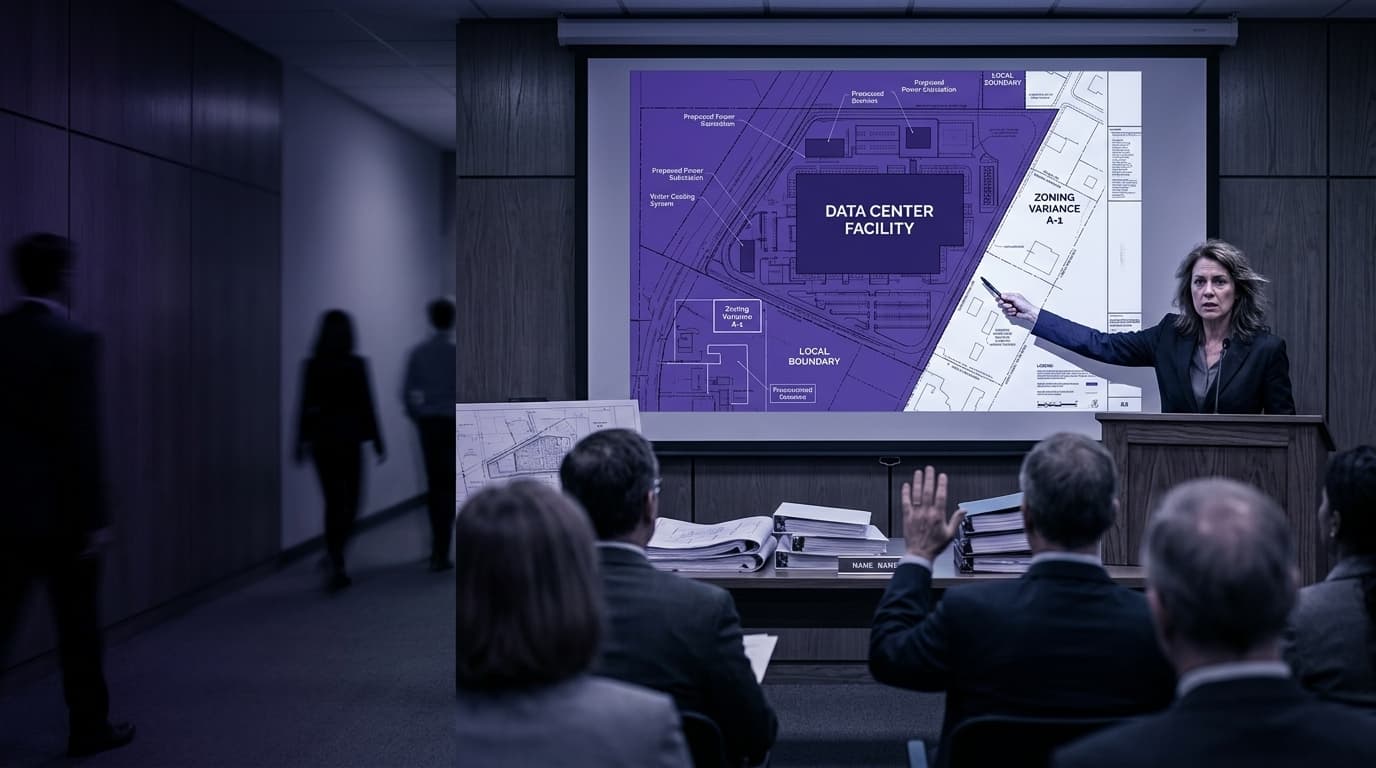
The new AI bottleneck is physical infrastructure and local zoning
··5 min read
Grassroots opposition halted $130 billion in data center construction in the first quarter of 2026, forcing enterprise technology leaders to rewrite their hardware strategies.
For the past two years, the fundamental limit on enterprise artificial intelligence was silicon. Technology leaders planned their roadmaps around GPU allocations, supply chain delays, and hardware procurement cycles. That era is over. The hardware constraint has shifted from the fabrication plant to the municipal zoning board.
During the first three months of 2026, local opposition successfully blocked or delayed at least 75 artificial intelligence data center projects across the United States. The halted developments represent an estimated $130 billion in capital investment, according to research from Data Center Watch. To understand the velocity of this shift, the volume of disrupted projects in the first quarter of 2026 roughly equalled the total disruptions recorded for the entirety of 2025.
This is not a temporary planning friction. It is a structural shift in the technology supply chain. If colocation providers and hyperscalers cannot secure the physical footprint and grid capacity required for high-density computing clusters, enterprise technology officers will inevitably face constrained compute availability and surging lease costs over the next 24 to 36 months.
The scale of the pushback
The resistance to digital infrastructure has rapidly professionalised and scaled. At the close of 2025, researchers tracked 396 active grassroots groups opposing data center construction. By March 2026, that number had more than doubled to 833 organisations operating across 49 states.
These campaigns are largely bipartisan and focus on highly localised consequences rather than abstract debates about artificial intelligence safety. Communities are mobilising against immense power grid strain, aggressive water consumption for cooling systems, noise pollution, and the threat of rising local electricity rates. In areas where massive campuses are proposed, residents increasingly argue that technology companies extract the resources while local utility ratepayers bear the infrastructural costs.
The political response has been immediate. State lawmakers introduced more than 300 bills related to data center regulation in the first six weeks of 2026. This marks a sharp reversal from the previous decade, when state governments competed aggressively to attract server farms with tax incentives and subsidies.
During the first quarter alone, lawmakers in 14 states proposed statewide moratoriums on new data center construction. The threat of outright bans is no longer hypothetical. While the governor of Maine narrowly vetoed what would have been the first statewide ban in April, the New York legislature recently passed a one-year moratorium on new facilities that exceed certain power thresholds, signaling a hardening regulatory environment.
Federal ambitions clash with local reality
Enterprise leaders assessing their capacity risks must understand the jurisdictional limits of federal policy. The United States government recognises the strategic necessity of expanding artificial intelligence infrastructure. Federal officials are actively pushing to streamline permitting processes to maintain global competitiveness in generative modeling and advanced computing.
However, federal directives do not override local utility regulations or municipal zoning laws. A federal mandate cannot force a county planning commission to approve a heavy industrial rezoning request, nor can it compel a local water authority to allocate millions of gallons of water per day to a cooling plant. The actual power to stall or stop these billion-dollar projects remains firmly in the hands of local authorities.
Rewriting the enterprise hardware roadmap
For technology executives, this geographic and political bottleneck requires an immediate recalculation of compute strategies. Relying on centralized, ultra-dense clusters in historically permissive locations is becoming a severe risk.
First, enterprises must factor rising infrastructure premiums into their artificial intelligence budgets. As supply constrains and developers are forced to relocate projects to less hostile but potentially less optimal regions, the costs of power, cooling, and real estate will be passed directly to the end user.
Second, architecture teams need to prioritize power efficiency alongside raw performance. The focus must shift toward distributed computing models, more efficient algorithms, and hardware that delivers higher output per watt. The companies that succeed in the next phase of artificial intelligence deployment will be those that learn to operate within strict energy budgets, rather than those that simply buy the most accelerators.
The supply chain for artificial intelligence is fundamentally physical. It requires steel, concrete, water, and immense amounts of electricity. As communities push back against the physical footprint of the digital economy, the primary job of the enterprise architect is no longer just managing software. It is managing the realities of the power grid.