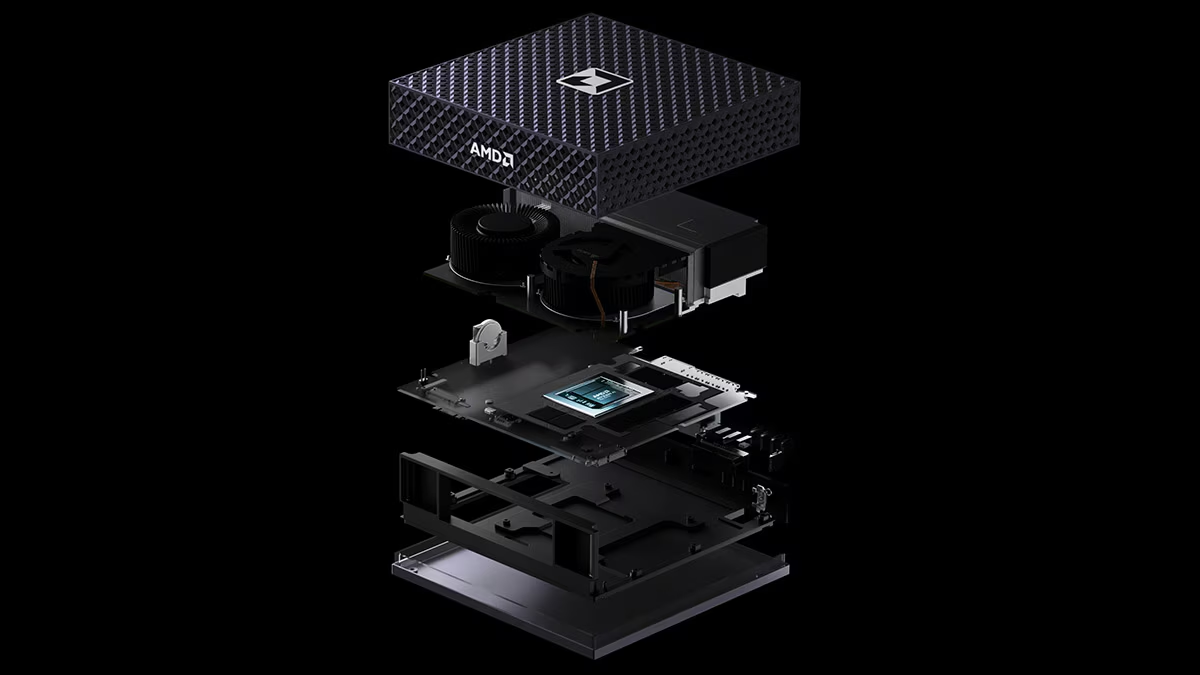
AMD challenges Nvidia on the desktop with the $3,999 Ryzen AI Halo
··5 min read
A localized hardware battle is brewing as AMD launches its first-ever branded workstation to take on Nvidia's DGX Spark.
For years, Advanced Micro Devices (AMD) operated under a strict division of labor: it designed the silicon, while hardware manufacturers built the actual machines. That playbook has changed. With the launch of the Ryzen AI Halo Developer Platform, AMD is shipping its first-party branded workstation directly to developers. Available exclusively through Micro Center for $3,999, the compact desktop is designed for a single task: running complex, agentic AI workloads locally.
This move marks a direct challenge to Nvidia's desktop ambitions. Just months after Nvidia began shipping the $4,699 DGX Spark, a miniature AI supercomputer built on its Grace Blackwell architecture, AMD has delivered an alternative that undercuts its rival in price while offering a fundamentally different architectural philosophy. The launch of the Ryzen AI Halo signals that the battle for AI developer loyalty is shifting from distant cloud data centres to the physical desk.
Under the hood of the Halo
At the heart of the Ryzen AI Halo sits the Ryzen AI Max+ 395 processor, a flagship silicon package built on a chiplet design. The processor combines 16 Zen 5 CPU cores with a Radeon 8060S graphics engine featuring 40 RDNA 3.5 compute units, alongside a dedicated neural processing unit capable of 50 TOPS. Crucially, the system features 128 GB of unified LPDDR5x memory operating on a wide 256-bit bus, providing 256 GB/s of bandwidth.
This unified memory architecture is the system's primary weapon. By sharing a single memory pool across the CPU and GPU, the platform can host models with up to 200 billion parameters without the overhead of paging data across PCIe lanes. In comparison, Nvidia's DGX Spark also ships with 128 GB of unified memory. However, Nvidia’s system relies on an Arm-based Grace CPU. This choice of architecture represents the primary fork between the two platforms.
By choosing an x86 foundation, AMD allows the Ryzen AI Halo to function as a dual-OS machine that boots native Windows 11 Pro or Linux. A developer can use the Halo as their primary daily workstation, running IDEs, office software, and local models on a single box. Nvidia’s DGX Spark runs a specialized, Ubuntu-based DGX OS. While the Spark excels as a dedicated local server, it cannot easily double as a general-purpose Windows desktop.
The software and quantization trade-offs
Despite the x86 advantage, AMD faces a steep technical hurdle in pure AI inference efficiency. Nvidia's Blackwell architecture features native support for FP4 quantization. This hardware-level compression allows the DGX Spark to run highly compressed models with over 100 billion parameters at speeds that exceed the physical limits of AMD’s standard memory bus. Early benchmarks suggest the DGX Spark remains the superior choice for developers focused purely on raw token throughput.
Furthermore, managing unified memory on Windows requires user intervention. Unlike Apple Silicon, which manages unified memory allocations behind the scenes, Windows treats system memory and graphics memory as separate pools. Developers using the Ryzen AI Halo on Windows must manually configure VRAM allocation in the system settings to ensure large models have access to the full 128 GB pool.
However, AMD has made significant progress in narrowing the software gap. The system ships with the ROCm software stack preloaded, along with a dedicated Developer Center app. This software hub provides native, out-of-the-box support for popular frameworks including PyTorch, vLLM, llama.cpp, and LM Studio. By removing the historically painful setup process of AMD software, the company is attempting to neutralize Nvidia’s CUDA advantage for local workflows.
A calculated retail strategy
AMD’s decision to launch the platform exclusively through Micro Center highlights a targeted approach to distribution. By bypassing traditional enterprise sales channels for the initial launch, AMD is pitching directly to the prosumer, academic researcher, and independent developer communities. These are the users most sensitive to the ongoing costs of cloud API subscriptions and the privacy risks of transmitting proprietary data.
Yet, the retail-first strategy also reveals some constraints. AMD has been opaque regarding broader global availability outside of its launch partner. While the $3,999 price point makes it more accessible than enterprise-grade server hardware, it remains a luxury purchase for individual developers.
Ultimately, the Ryzen AI Halo is a statement of intent. By building its first branded desktop, AMD is acknowledging that software development tools are as critical as silicon design. If the platform can convince developers that ROCm is a viable, pain-free alternative to CUDA, AMD will have successfully established a beachhead in the local AI market.