
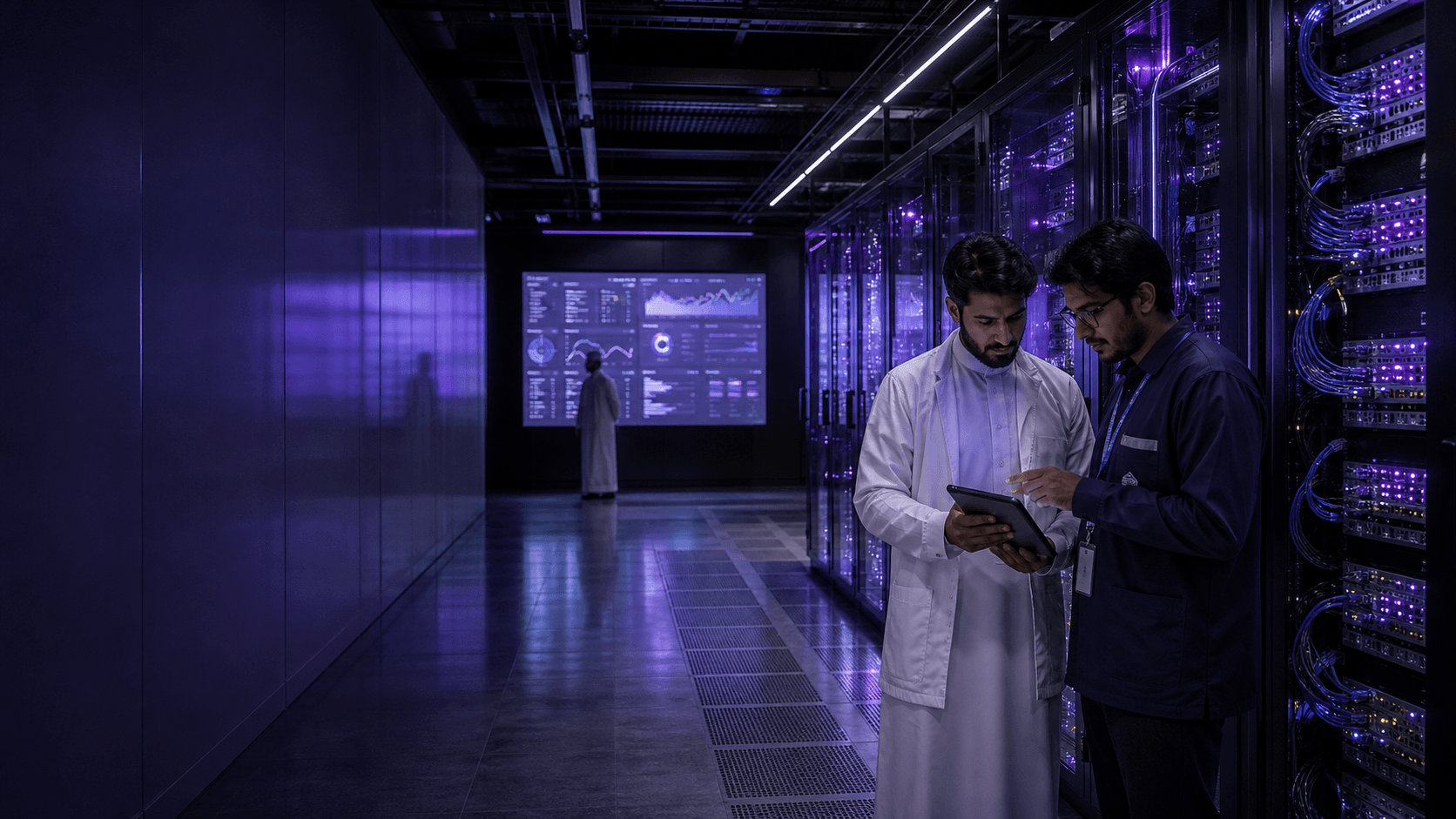
stc group has deployed a Huawei-developed Green Telco Cloud platform in Saudi Arabia, giving one of the Gulf’s most important telecom infrastructure players a new consolidated layer for compute, storage and networking. The announcement is narrow in one sense, since it concerns carrier infrastructure rather than a hyperscale cloud region. But for AMD’s EMEA ecosystem, the signal is broader: Middle East telecom cloud buying is moving toward energy efficiency, density, automation and carbon visibility as core procurement criteria, not secondary sustainability language.

stc said on 11 June 2026 that the platform combines telecom workloads in a single integrated environment built on Huawei’s cloud-native architecture. The system uses energy-efficient servers, dynamic power management and adaptive CPU frequency scaling, with a central dashboard for full-stack telemetry, carbon impact analytics and automated shutdown of idle resources [1].

The strongest numbers in the announcement come from joint lab trials by stc and Huawei. The companies said the platform, using Huawei green technologies, achieved up to 20 percent lower energy consumption and a 40 percent reduction in physical infrastructure [1]. Those are useful figures, but they should be read carefully. They are vendor and operator lab claims, not independently verified field benchmarks, and the announcement does not disclose the hardware bill of materials, production workload mix, deployment scale or baseline configuration.

Why this matters beyond one Saudi deployment

The reason this deployment matters is not that every operator will buy the same Huawei stack. It is that stc is putting measurable infrastructure efficiency at the centre of telco cloud modernisation.

Carrier clouds are becoming the substrate for 5G-Advanced, enterprise connectivity, IoT platforms, edge services and, increasingly, AI inference closer to customers. TelecomLead reported on 12 June 2026 that the Green Telco Cloud is intended to support next-generation services such as 5G-Advanced while cutting emissions and improving operational efficiency [2]. That framing turns the deployment into more than a network upgrade. It is a marker for how regional operators may evaluate the next phase of distributed cloud infrastructure.

stc’s own position in the market makes the move more relevant. The group describes itself as a regional digital enabler, with businesses spanning digital infrastructure, cloud computing, cybersecurity, IoT, digital payments, digital media and digital entertainment [3]. In that context, a more efficient telco cloud is not only a way to run network functions. It can become part of the infrastructure base for enterprise products, managed services and edge workloads across Saudi Arabia and adjacent markets.

For server OEMs, silicon vendors and systems integrators selling into the region, the lesson is plain. Capacity alone is no longer the cleanest argument. Operators are asking how much workload can fit into fewer racks, how power use changes with traffic, how idle resources are detected, how carbon impact is measured and how much control the operations team has over the full stack.

The Huawei advantage and the opening for rivals

Huawei’s role is commercially important because the Green Telco Cloud is presented as an integrated architecture rather than a loose collection of components. The announcement describes hardware, cloud-native software and operations telemetry as parts of one system, with intelligent controls running across the environment [1]. That is a strong proposition for operators that want accountable outcomes and fewer integration seams.

It also raises the competitive question for AMD partners in EMEA. If Middle East operators gravitate toward tightly integrated vendor stacks for AI-era network cloud, alternative CPU, accelerator and open cloud vendors will need a sharper story than generic openness. They will have to show credible efficiency gains at the rack and platform level, not only benchmark wins at the chip level.

AMD already frames EPYC for telecom and networking around energy-efficient x86 servers, cloud-native 5G performance and performance per watt [4]. The company has also pointed to EPYC 8005 and 8004 systems for telco, edge and cloud storage environments, including single-socket designs for power-constrained deployments [5]. In 2025, AMD said Nokia had selected 5th Gen EPYC processors for Nokia Cloud Platform, specifically citing performance and energy efficiency for next-generation telecom infrastructure [6].

Those proof points matter, but the stc-Huawei deployment suggests the market is moving from component claims to system claims. A rival offer will need to connect silicon efficiency with orchestration, observability, resource automation and lifecycle management. In practical terms, an EPYC-based server pitch must be accompanied by a credible answer on idle power, workload placement, telemetry integration and operational simplicity.

Telco cloud becomes an AI-era infrastructure test

The Middle East cloud market is often discussed through the lens of hyperscaler regions, sovereign cloud partnerships and national AI programmes. Carrier cloud deserves more attention because it sits closer to the network edge and the enterprise customer. It is where latency-sensitive services, private connectivity, network slicing and distributed inference may eventually meet.

That does not mean the Green Telco Cloud should be treated as an AI infrastructure breakthrough. stc and Huawei have not disclosed whether the deployment includes accelerators, what production services are running on it, or how much traffic it currently supports. The announcement is stronger as evidence of procurement direction than as evidence of operational transformation already achieved.

The direction is still important. Gulf operators face a hard infrastructure equation: more traffic, more cloud-native network functions, more AI-adjacent services and more pressure to contain energy use. If they can cut physical infrastructure while improving automation, the commercial case is not only environmental. It is about site constraints, power budgets, operational labour and faster service deployment.

That is where AMD’s regional ecosystem should read the deployment as a warning as much as an opportunity. Huawei is selling a controlled system with a sustainability and operations narrative wrapped around it. Competing stacks built on EPYC CPUs, Instinct accelerators or open telco cloud software will need to prove that heterogeneous infrastructure can deliver comparable efficiency without forcing operators into a closed operational model.

The next contest in Middle East telco cloud may therefore be less about who can promise the most raw compute and more about who can make that compute governable. For operators such as stc, the winning platform will be the one that turns power, space, telemetry and automation into measurable infrastructure economics.

Sources

  1. stc group and Huawei Launch Green Telco Cloud, Accelerating the Future of Sustainable Telecom in the Region
  2. stc Group and Huawei Launch Green Telco Cloud to Advance Sustainable Telecom Infrastructure
  3. Telecom news: IEC Telecom, STC Group, Huawei, O2, Mavenir