US block on Anthropic models accelerates European push for AI sovereignty
··5 min read
The abrupt global shutdown of Fable 5 and Mythos 5 has transformed theoretical vendor risks into an active operational crisis for European technology leaders.
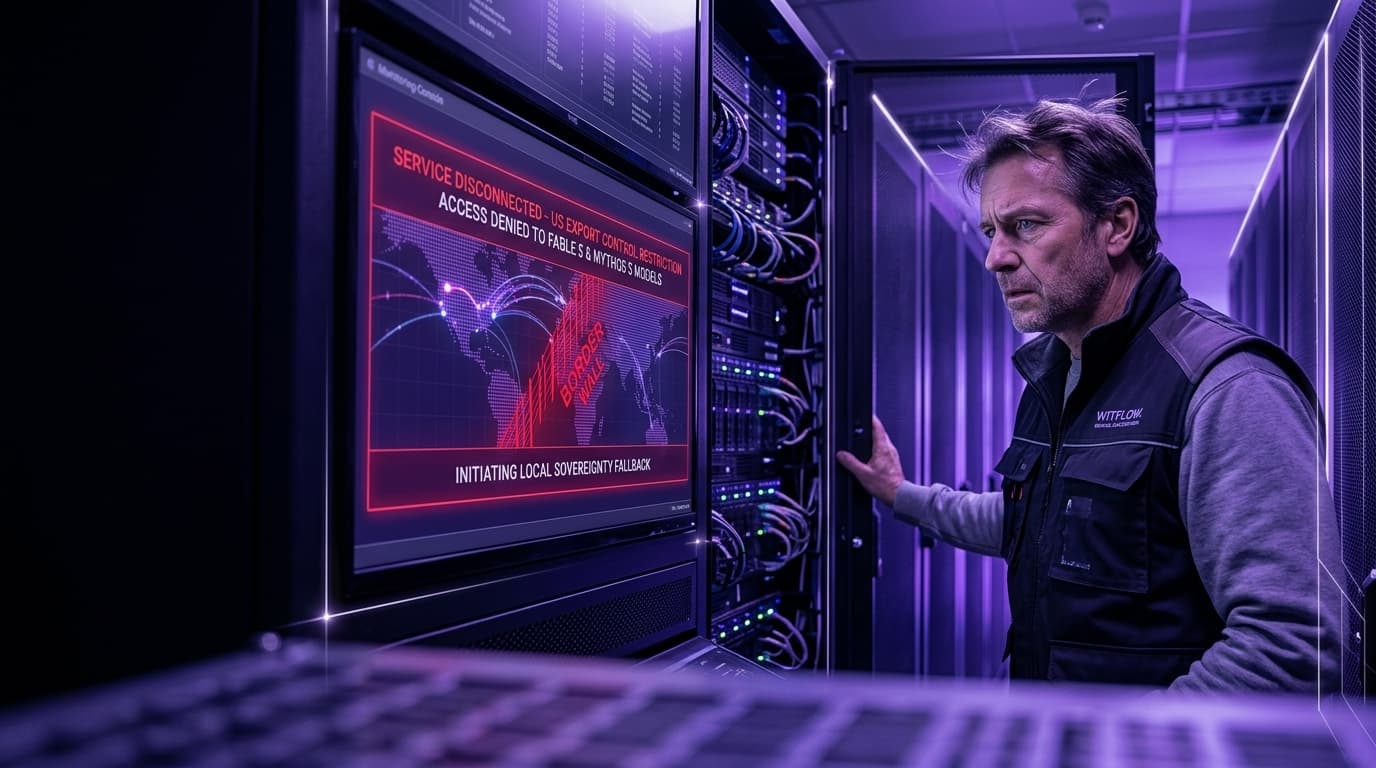
The sudden suspension of Anthropic's Fable 5 and Mythos 5 models has erased any lingering illusion that European enterprises enjoy guaranteed access to US artificial intelligence infrastructure. Following a June 12 export-control directive from the US Department of Commerce, European businesses found themselves abruptly cut off from two of the market's most capable foundation models. The intervention, rooted in US national security concerns, was executed without warning.
This shutdown is not a hypothetical compliance drill. It is an active disruption of enterprise technology deployments across the continent. Legal and compliance teams must urgently reassess vendor lock-in, while technology strategists face mounting political pressure to adopt European-native AI infrastructure. Lawmakers are already seizing on the incident to expand the scope of the proposed Cloud and AI Development Act (CAIDA).
The mechanics of the disruption highlight the fragility of the global AI supply chain. The US directive ordered Anthropic to suspend model access for all foreign nationals due to fears that the systems could be exploited. Because the company could not reliably filter users by nationality in real time, it disabled access to Fable 5 and Mythos 5 globally. This sudden blackout affected all regions and third-party distribution channels, including Amazon Web Services.
The models had been public for only three days before the sweeping restriction took effect. Enterprise development teams across Europe lost access to systems they were actively evaluating and integrating. The speed of the shutdown left no time for a planned transition to backup models, forcing companies to scramble for alternatives and rewrite application logic.
The political response and CAIDA expansion
European officials immediately framed the blackout as a vindication of their technological sovereignty agenda. On June 15, European Commissioner for Tech Sovereignty Henna Virkkunen publicly rebuked the US action. She asserted that Europe poses no security risk and called for the swift adoption of mechanisms to protect the bloc's digital autonomy. The political messaging is clear: reliance on American providers is now viewed as a critical vulnerability.
French Digital Minister Anne Le Hénanff echoed this sentiment, stating that the sudden shutdown strengthens her resolve for stricter tech sovereignty frameworks. Le Hénanff signalled potential support for expanding obligations on private-sector operators. This marks a meaningful shift in the legislative debate, moving the conversation from voluntary public-sector guidelines toward potentially binding requirements for private enterprises.
The Anthropic suspension has directly intensified negotiations around CAIDA. The legislation proposes a tiered cloud sovereignty framework, with the highest security tiers demanding infrastructure that is fully localised and governed within Europe. Before the US intervention, the debate focused on whether these strict rules should apply primarily to sensitive public-sector workloads.
Now, policymakers are using the disruption to argue that private enterprise data requires the same protection. Lawmakers contend that voluntary measures fail to shield European businesses from foreign technology cutoffs. The renewed push centres on forcing critical private entities to assess their vulnerabilities and shift essential workloads to domestic cloud and AI providers.
The enterprise reality
Yet the political demand for European sovereignty collides with the reality of the current AI market. The European Union currently lacks a domestic foundation model equivalent to Fable 5 or the sovereign computing scale required to replace US hyperscalers. European enterprises rely on American AI systems precisely because they offer unmatched performance for complex reasoning and software engineering tasks.
Building a true European alternative requires massive capital investment and access to constrained global supply chains for advanced semiconductors. The leading European cloud providers currently lack the infrastructure scale of their US counterparts. Mandating a shift to European providers before the capacity exists could force companies to choose between regulatory compliance and global competitiveness.
CAIDA's strict assurance levels are designed to protect against third-country interference. However, forcing enterprises off US systems prematurely would create severe performance and productivity gaps. European businesses could find themselves at a distinct disadvantage if they are walled off from the most capable global models while their international rivals continue to advance.
For enterprise technology leaders, the incident serves as a definitive warning. Building critical applications entirely on proprietary foreign models carries immediate sovereign risk. Technology strategy teams must now audit their AI dependencies and architect multi-model fallback solutions. They must prepare for a highly fragmented regulatory landscape where access to frontier systems can be revoked at any moment.
Sources
US AI shutdown boosts calls for stricter rules in EU tech sovereignty law (Euractiv)
EU tech chief says Europe 'not a security risk' after US AI order (The Economic Times)
The United States cuts off access to Anthropic's Fable 5 and Mythos 5 models: a precedent for AI sovereignty (ActuIA)