Why the most powerful AI in healthcare is moving offline
··4 min read
Cloud computing clashes with medical privacy laws, driving a quiet migration toward localized, multi-agent networks running directly on hospital hardware.
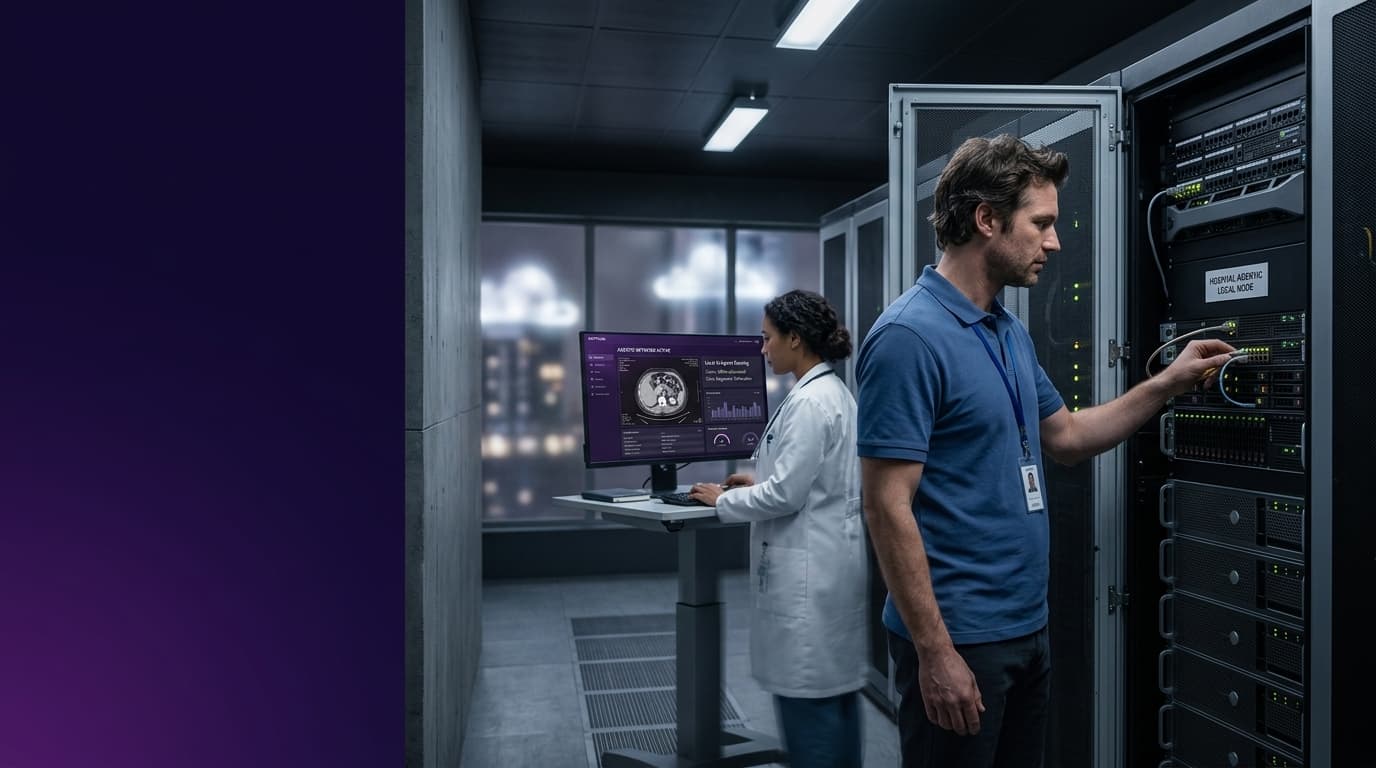
Cloud computing and medical privacy have never been natural allies. Every time a hospital tool sends patient data to an external server for processing, it triggers a cascade of compliance risks under privacy frameworks like HIPAA. For years, this tension slowed the adoption of artificial intelligence in medicine. But in 2026, healthcare providers are bypassing the cloud entirely. They are migrating to local, multi-agent AI networks that operate directly on clinic workstations and hospital servers.
This shift marks a structural change in how medical intelligence is deployed. Instead of relying on a single, massive cloud model, hospitals are running specialized teams of smaller models on their own hardware. These local agentic teams are quietly solving the industry's heaviest administrative and clinical bottlenecks, without ever connecting to the open internet.
The mechanics of local multi-agent teams
A multi-agent system does not function like a generic chatbot. It operates as a collaborative workforce. In a clinical setting, tasks are divided among specialized, role-based agents. When a doctor sees a patient, one local agent might transcribe the audio, while a second agent cross-references the transcript against the patient's electronic health record. A third agent then automatically translates the clinical notes into standard billing codes. Finally, a supervisor agent audits the entire workflow for accuracy and clinical safety guardrails.
Crucially, modern orchestration tools and optimized local models allow these complex workflows to run entirely on premises. Because the data never leaves the facility, the compliance burden drops significantly. Organizations no longer have to sign complex Business Associate Agreements with external cloud providers or worry about their data being used to train third-party models.
Democratizing access for small clinics
For independent practices and rural health centers, the local agent model is transformative. Historically, advanced healthcare software required expensive enterprise licenses and massive IT infrastructure. Today, open-source frameworks and affordable AI-capable hardware allow a three-person clinic to run sophisticated automation on standard office machines.
These local systems take over the administrative burden that routinely burns out small medical teams. Agents can manage local scheduling, process patient intake forms, and organize prior authorization requests. By keeping processing on the device, small practices bypass the recurring API costs of cloud platforms. They also retain absolute control over their patient data, allowing them to modernize their operations without inviting regulatory scrutiny or risking data exfiltration.
Speed and scale in large hospital networks
For massive health systems and medical device manufacturers, the advantage of local AI is latency. In acute care, relying on a cloud connection introduces unacceptable delays. Processing voice commands or vital signs through an external server can take seconds, a delay that disrupts fast-paced clinical workflows.
To solve this, large providers are embedding AI agents directly onto medical devices and edge gateways. In a modern intensive care unit, a multi-agent system running on a local server can monitor dozens of beds simultaneously. One agent might analyze continuous vital signs to predict early sepsis, while another filters out the false alarms that frequently cause alarm fatigue among nurses. In radiology, local agents handle pre-interpretive image analysis right on the workstation, giving specialists immediate insights without waiting for a cloud round-trip.
New hardware and governance challenges
The move to local execution solves external privacy problems but introduces new internal friction. Keeping data in-house means the hospital is entirely responsible for the infrastructure.
Running multiple agents simultaneously requires serious computational power. Health organizations are having to upgrade their local hardware, investing in advanced graphics processing units and neural processing units to ensure their local networks do not bottleneck.
Furthermore, local agents create internal data sprawl. As these autonomous systems work, they generate vast amounts of operational data, including conversation caches, vector databases, and detailed activity logs. Because this operational data contains protected health information, IT departments must build strict internal access controls to ensure the agents themselves do not inadvertently expose sensitive records to unauthorized staff.
The closed-door future of medical AI
The narrative that artificial intelligence requires massive, centralized cloud computing is fracturing. In highly regulated sectors, data sovereignty dictates the architecture.
By deploying multi-agent teams onto local machines, the healthcare industry has found a way to harness autonomous intelligence without compromising patient trust. The operational efficiency of the clinic and the diagnostic speed of the hospital are no longer reliant on external tech giants. The most powerful medical software is now running entirely behind closed doors.